




Blog Summary
Learn how commodity markets work in the UAE and how commodities trading works in this beginner-friendly guide. Discover how the commodity market operates through exchanges, futures, CFDs, and ETFs, explore key participants in the UAE’s energy and gold-driven economy, understand the main factors that influence commodity prices, and learn practical steps to start trading in 2026 with exposure to global markets.
Table of contents
Commodity markets play a major role in the UAE’s economy and its position as a global trading hub. With Dubai and Abu Dhabi acting as key financial and logistics centres, the country connects Asian, European, and African markets through energy, metals, and agricultural commodity flows. From gold traded in Dubai’s physical markets to crude oil linked with Abu Dhabi’s energy sector, commodities remain central to both the regional economy and international trade.
Understanding how the commodity market works in the UAE helps traders and investors make more informed decisions, manage risk, and diversify across different asset classes. The UAE is especially active in precious metals, energy products, and re-exported goods, making it a strategic location for commodity-related activity.
Commodity trading in the UAE operates through a mix of spot markets, futures contracts, and regulated exchanges. Institutions and professional traders often access global pricing through exchanges and platforms, while local physical markets, especially in gold and energy-linked products, continue to play an important role. The regulatory environment, supported by financial centres like ADGM in Abu Dhabi and DIFC in Dubai, helps ensure transparency and structured market access.
What Are Commodity Markets?
Commodity markets are financial marketplaces where raw materials and natural resources are bought and sold. In the UAE, these markets are closely linked to global trade flows, especially through Dubai’s role as a regional hub for gold and metals and Abu Dhabi’s influence in global energy markets. These markets help determine the prices of essential goods used across industries, from construction and manufacturing to food production and energy supply.
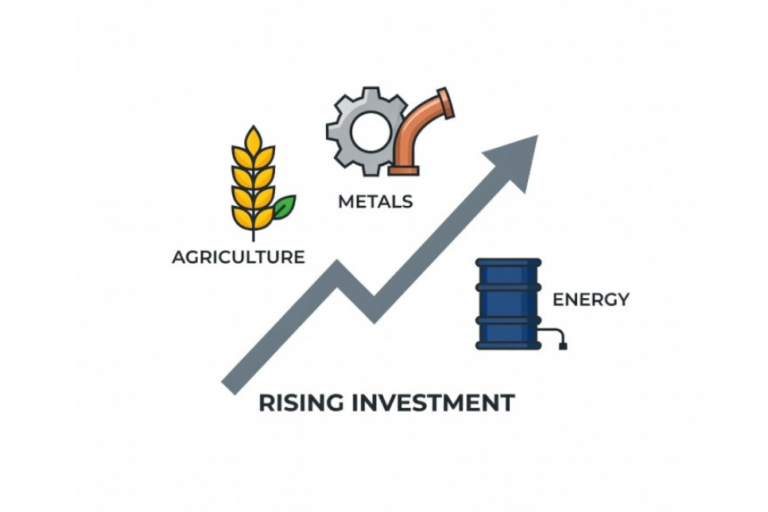
Examples of commonly traded commodities include:
Energy Commodities
- Crude Oil
- Natural Gas
- Heating Oil
- Gasoline
Metal Commodities
- Gold
- Silver
- Copper
- Platinum
- Palladium
Agricultural Commodities
- Wheat
- Corn
- Soybeans
- Coffee
- Sugar
- Cotton
Commodity markets in the UAE allow producers, importers, and exporters to manage price risk in a globally connected trading environment. At the same time, they provide traders and investors with opportunities to engage with price movements across energy, metals, and agricultural products influenced by global supply and demand.
How Commodity Markets Work
To understand how commodity markets work in the UAE, it helps to look at the different participants involved and how they interact within a globally connected trading environment. The UAE acts as a key link between regional producers and international markets, particularly in energy and metals.
Commodity markets bring together:
- Producers
- Manufacturers
- Distributors
- Institutional investors
- Speculators
- Retail traders
For example, an energy producer in the region may aim to secure a stable future price for crude oil, while a manufacturer or importer may look to lock in supply costs to manage budgeting and reduce uncertainty. Commodity markets help both sides reduce exposure to price volatility.
At the same time, traders and investors participate in these markets to take advantage of price movements driven by global economic trends, geopolitical developments, and shifts in supply and demand.
In the UAE, this interaction is shaped by strong international trade links and well-established financial infrastructure in hubs like Dubai and Abu Dhabi, where commodity-related activity is supported by both physical trade and financial instruments.
How Does the Commodity Market Work?
Many beginners ask, how does the commodity market work in practice.
Commodity markets operate through regulated exchanges where standardized contracts are traded. Instead of physically buying barrels of oil or shipments of wheat, most participants trade contracts that represent the value of these commodities. In the UAE, this activity is closely connected to global pricing systems and regional trading hubs that link local markets with international exchanges.
The trading process generally follows these steps:
- Market participants place buy or sell orders.
- Exchanges match buyers and sellers.
- Transactions are recorded electronically.
- Prices update continuously based on supply and demand.
- Traders either close positions before expiration or settle contracts according to market rules.
Modern commodity markets in the UAE and globally operate almost entirely through electronic trading systems, making access faster, more transparent, and closely aligned with international market movements.
Major Commodity Exchanges in the UAE and Globally
Commodity trading occurs on exchanges around the world.
Some of the most important include:
Exchange | Primary Focus |
CME Group | Energy, metals, agriculture |
COMEX | Precious metals |
NYMEX | Energy products |
ICE | Commodities and futures |
Dubai Mercantile Exchange (DME) | Crude oil and energy benchmarks |
These exchanges help ensure transparency, liquidity, and fair pricing.
The Main Participants in Commodity Markets in the UAE
Understanding how commodities trading works requires understanding the participants involved.
Commodity markets in the UAE are shaped by a strong mix of domestic activity and international flows, supported by major trade hubs such as Dubai and Abu Dhabi and regulated financial centres like DIFC and ADGM.
Producers
Producers are the companies and entities that extract or generate physical commodities.
Examples include:
- Oil and energy producers in Abu Dhabi and the wider UAE
- Mining and metals suppliers linked to global trade flows
- Agricultural producers from regional and international markets
- Commodity exporters operating through UAE free zones
Producers use commodity markets to lock in future selling prices and reduce exposure to global price volatility, especially in energy-linked sectors.
Commercial Buyers
Commercial buyers use commodities as part of their business operations and supply chains.
Examples include:
- Airlines purchasing jet fuel for operations
• Food manufacturers sourcing grains and raw materials
• Jewellery and gold retailers operating in Dubai’s gold market
• Industrial companies relying on metals and energy inputs
In the UAE, commercial demand is especially strong due to aviation, logistics, construction, and re-export industries. These buyers use commodity markets to stabilise costs and manage long-term planning.
Institutional Investors
Large institutions participate in commodity markets to diversify portfolios and manage risk.
Examples include:
- Hedge funds
- Pension funds
- Asset managers
The UAE’s regulatory centres such as Dubai Multi Commodities Centre and financial ecosystems like ADGM and DIFC support institutional participation by providing structured access to global commodity markets.
Retail Traders
Individual traders speculate on price movements using platforms and brokers.
Retail participation in the UAE has grown due to easier access to digital trading systems, improved market transparency, and exposure to global commodity pricing. Many retail traders engage in gold, oil-linked instruments, and other major commodities through regulated platforms connected to international exchanges such as Dubai Gold and Commodities Exchange.
Retail trading is typically driven by short to medium-term price movements and global economic trends.
How Commodities Trading Works in the UAE
Learning how commodities trading works involves understanding the main instruments used by traders and investors in the UAE’s globally connected markets. From energy-linked assets to precious metals, participants access commodities through regulated exchanges, financial centres, and brokerage platforms that connect local markets with international liquidity.
Futures Trading
Futures contracts are among the most popular commodity trading instruments.
A futures contract is an agreement to buy or sell a commodity at a predetermined price on a future date.
For example:
A trader may agree to purchase gold at $3,500 per ounce three months from now. If gold rises before expiration, the contract may increase in value.
CFD Trading
Contracts for Difference (CFDs) allow traders to speculate on commodity price movements without owning the physical asset.
Benefits include:
- Ability to trade rising and falling markets
- Lower capital requirements
- No physical delivery
ETFs
Commodity ETFs allow investors to gain exposure to commodity prices through stock exchanges.
Popular categories include:
- Gold ETFs
- Silver ETFs
- Energy ETFs
- Agriculture ETFs
Commodity Stocks
Many investors gain exposure through commodity-related companies.
Examples include:
- Gold mining companies
- Oil producers
- Agricultural businesses
Commodity stocks often move alongside the underlying commodity prices.
What Drives Commodity Prices in the UAE?
Commodity prices are constantly changing due to global and regional market forces. In the UAE, pricing is strongly influenced by international supply chains, energy markets, and the country’s role as a major trading hub connecting East and West.
Supply and Demand
This is the most important factor.
If supply falls while demand remains strong, prices often rise.
If supply increases faster than demand, prices may fall.
Economic Growth
Strong economic growth increases demand for:
- Oil
- Copper
- Steel
- Industrial metals
Weak economic conditions often reduce demand.
Inflation
Commodities are often viewed as inflation hedges.
When inflation rises, investors frequently increase commodity exposure.
Weather Conditions
Agricultural commodities are particularly sensitive to weather events.
Examples include:
- Droughts
- Floods
- Hurricanes
- Extreme temperatures
Geopolitical Events
Political instability can disrupt supply chains and create price volatility.
Energy markets are especially sensitive to geopolitical developments.
Current Commodity Market Trends in 2026
Commodity markets continue to evolve as new economic and technological trends emerge.
Energy Transition
The global shift toward renewable energy has increased demand for industrial metals such as:
- Copper
- Lithium
- Nickel
- Cobalt
These commodities play critical roles in electric vehicles and battery technology.
Central Bank Gold Purchases
Many central banks continue increasing gold reserves, supporting long-term demand for precious metals.
Supply Chain Realignment
Global companies are diversifying supply chains, creating new demand patterns across commodity markets.
Inflation and Interest Rates
Commodity prices remain sensitive to central bank policies and inflation expectations.
These trends highlight why understanding how commodity markets work remains important for investors in 2026.
Benefits of Commodity Trading
Diversification
Commodities often move differently than stocks and bonds.
Inflation Protection
Many investors use commodities as a hedge against inflation.
Global Exposure
Commodity markets reflect worldwide economic activity.
High Liquidity
Major commodities such as gold and crude oil are highly liquid.
Risks of Commodity Trading
Price Volatility
Commodity prices can move rapidly.
Leverage Risk
Many trading products use leverage, increasing both profits and losses.
Economic Risk
Changes in growth expectations can significantly impact commodity prices.
Geopolitical Risk
Unexpected political events can create substantial market volatility.
Proper risk management is essential.
How Beginners Can Get Started
Step 1: Learn Market Fundamentals
Understand supply and demand dynamics.
Step 2: Choose a Regulated Broker
Select a trusted commodity broker with commodity market access.
Step 3: Use a Demo Account
Practice before risking real capital.
Step 4: Focus on Major Commodities
Many beginners start with:
- Gold
- Silver
- Crude Oil
Step 5: Manage Risk
Use stop-loss orders and appropriate position sizing.
Commodity Markets vs Stock Markets
Commodity Markets | Stock Markets |
Trade physical resources | Trade company ownership |
Influenced by supply and demand | Influenced by company performance |
Often used as inflation hedges | Often focused on long-term growth |
Highly sensitive to global events | More influenced by business results |
Both markets can complement each other within a diversified portfolio.
Final Thoughts
Understanding how commodity markets work is essential for anyone interested in global financial markets, especially in a highly connected hub like the UAE. Commodity markets influence everything from fuel prices and food costs to industrial production and inflation trends across both local and international economies.
Learning how the commodity market works helps investors understand the forces that drive price movements, while understanding how commodities trading works opens access to one of the world’s oldest and most important financial markets. These markets reflect real-world supply and demand, making them a key indicator of global economic conditions.
Whether focused on precious metals, energy products, or agricultural commodities, these markets offer opportunities for diversification and exposure to global trends.
Trade 24/7, an SCA-regulated broker, provides access to commodity markets through MT5, allowing traders to monitor prices, analyze trends, and manage positions using professional trading tools.
FAQs
Commodity markets work by connecting buyers and sellers of raw materials such as oil, gold, and agricultural products. Prices are determined through supply and demand.
In the UAE, commodity markets operate through regulated exchanges and electronic trading platforms. Participants trade contracts linked to commodities rather than physical goods, and these markets are supported by financial centres such as DIFC and ADGM, which help ensure transparency and efficient market access.
Commodity trading works by speculating on the price movements of commodities through instruments such as futures contracts, CFDs, ETFs, and commodity-related stocks.
Commodity markets are important in the UAE because the country is a major global hub for energy, gold, and re-export trade. These markets support price discovery, enable risk management for businesses, and strengthen the UAE’s position in international trade and finance.
Yes. Beginners in the UAE can start with education, demo trading accounts, and highly liquid commodities like gold and crude oil. Many traders also use regulated platforms and brokers to access global markets in a structured and secure environment.
Ready to Trade Like a Pro?
Open Your Account